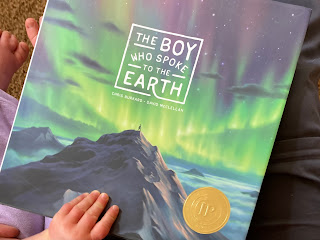
The Boy Who Spoke To The Earth

      At bedtime, I asked my daughter how to say "fish." She signed fish next to her mouth. I thought she had picked it up that way since we ate tuna fish from a can for lunch that day. The next day she pulled this book off the shelf again and I realized that she had signed fish next to her mouth because the bear had a fish in its mouth.


     Two years ago when my husband and I visited Arches National Park we stopped in at the Visitor Center and this book caught my eye because of the beautiful pictures. Those same eye-catching pages are what draws and keeps my almost-two-year-old's attention. She loves finding the hidden animals on the pages and laughs at the squirrel on the very last page. This is a good book for "Where's the ____?" and "What's that called?" type questions. I like that the boy goes to the far reaches of the earth through different biomes and the pictures become full panoramic images when the boy starts seeing instead of only looking. The illustrations reference our National Parks and showcase their wildlife. 
     The story is the boy in search of happiness. What is happiness? Where is happiness found? The boy must learn to stop and stand still to truly see and not just look. I like that the author uses alliteration "waded and he wandered" or "hiked and he hauled." At the end of the story the boy found that happiness was all around him. I think the book reminds us to look for and appreciate the good and lovely things (Phil. 4), and to pause long enough to truly see and hear to take in with all your senses what is around you. The book reminds me to "[B]e still and know that I am God" as it says in Psalm 46:10.
     This book is written by Chris Bukkard and David McClellan, published in 2015 by Dreamling Books out of Salt Lake City. The pictures allow for this book to be enjoyed by all ages. If you see this book at a National Park Visitor Center you should definitely check it out. The book is also available through most libraries or interlibrary loan programs.


Activities to pair with the book:
-go hiking on a local trail
-sit still under a tree looking up at the branches and the wildlife in it
-lay quietly on the grass and look at the bugs that crawl around
-visit state and national parks


Comments

Popular posts from this blog

Letter Knowledge

5 Alphabet Books We Have Been Reading My daughter, now 3 years and 9 months old, was talking with me after school earlier this week. She was asking me to tell her how many letters I knew, I quickly answered "26." Then I asked her how many letters she knew. Her answer was "29."  Letter knowledge is one of the skills needed before one can read. Yes, there are 26 letter names but letter knowledge is also knowing the sounds of those letters which includes 44 English phonemes (25 constant sounds and 19 vowel sounds). Learning 26 letters includes knowing both upper and lower case letters, so knowing how to identify 52 shapes. And then there is the issue of different fonts and sizes of the letters. My daughter has been enjoying the magnetic alphabet letters that we have and we were just gifted a set of lowercase magnetic letters. She loves to line up a long string of letters and have us read what she wrote, ha! An uncle of hers does a great job of reading her writing and i...

Interactive Books

Interactive Books: 9 Subcategories of Interactive Books   Over Spring Break I was reading an interactive book,  Bunny Slopes , to my daughter with my daughter on her Grandma's lap. We got a couple of pages in and she looks over to her Grandma and says "I love this book, this is my favorite, do you love this book?" So what is an interactive book? An interactive book draws readers in and asks them to participate with the story in some way. When books are fun and playful, it strengthens their love for reading which in turn makes learning to read easier for them. Print Motivation is one of the six early literacy skills  that have been identified that children must know before they learn to read. In order to promote print motivation one must enjoy books. Interactive books can also: promote independence, hand-eye coordination, understanding that reading is from left to right, fine-motor practice, sensory outlets and other skills like 'good readers make predictions' (wha...

Point with your Finger

Mo Willems' Books and Tips to Grow a Reader "No! Point with your finger!" Our daughter has been shouting at us these words as we read her books. I think it helps her stay focused and it is a way in which she is learning to read more words. Tracking the words as we read helps to connect the fact that what we are reading is what is on the page. An article from Learning Without Tears says: "And be sure to use your finger to point to letters and words, which helps kids connect print and speech." Lastly, pointing to the words as we read to our children shows them the pathway words take on the page; left to right and up to down.  As I told someone this weekend when they asked if she could read, "Yes, she is quite the reader." So what am I doing to help her grow her reading skills and what books are we reading? Continue reading below to see some ideas we are doing to get her thinking about words. As far as what books we focus on, we read all sort of books an...